Most people researching a tummy tuck aren’t afraid of the surgery itself. They’re afraid of the recovery — specifically, not knowing what it actually looks like in real life. How many days do you need help at home? When can you drive your kids to school? Can you make it to a work event at week three, or is that pushing it?
These are the questions that matter, and they deserve straight answers. We’ve been performing tummy tucks in Fairfield County, CT for over 30 years, and what follows is an honest, week-by-week look at what recovery actually involves — so you can plan around your life, not just around a surgery date.
Recovery Time After Tummy Tuck: What the Timeline Actually Looks Like
The short answer most surgeons give is “two to six weeks,” which technically isn’t wrong — but it leaves out a lot. There’s a difference between feeling functional and being fully healed, and those two things happen on very different schedules.
Most patients feel meaningfully better around week two. They’re moving around the house, sleeping more comfortably, and starting to feel like themselves again. But the internal healing — muscle repair settling, swelling resolving, the scar maturing — that process runs much longer. Final results typically become visible somewhere between nine and twelve months after surgery. That’s not a complication. That’s just how the body heals.
The more useful way to think about tummy tuck downtime is in two parallel tracks: how quickly you can function, and how long until you look the way you expect. Both matter. Both move at their own pace.
Week-by-Week Tummy Tuck Recovery: What Changes and When
The first 72 hours are the hardest. Swelling, bruising, soreness, and fatigue are all completely normal — your body just went through a significant procedure, even a carefully controlled one. You’ll be resting, managing discomfort with prescribed medication, and wearing a compression garment around the clock. If you had muscle repair as part of your procedure, you’ll feel a tightness through your midsection that’s more pronounced than the incision itself. Most patients describe this phase not as sharp pain but as heaviness, pulling, and deep soreness.
By the end of week one, most patients are moving around the house with more confidence. You’ll still be tired. You’ll still need help — with meals, with getting in and out of bed, with anything that requires bending or lifting. This is not the week to push it. We typically see patients in our office around day five for an initial post-op check, at which point we assess healing, replace your compression garment, and address any questions.
Week two is when most people start to feel like they’re turning a corner. Swelling is still present, but the worst of the initial discomfort has passed. If you have a desk job, this is generally when returning to work becomes realistic — provided you’re off prescription pain medication, can sit comfortably for stretches of time, and have someone else handling the driving. For patients commuting into New York City on Metro-North from Greenwich, Darien, or Westport, the train is a reasonable option around this point, but plan for the fatigue. A full commute day is more taxing than it sounds when you’re two weeks post-op.
Weeks three through six involve a gradual return to normal activity. Most visible bruising is gone. Swelling continues to improve but is still noticeable, particularly in the lower abdomen. You’re still in your compression garment. Light walking is encouraged; anything more strenuous is not. At the six-week mark, most patients are cleared to return to the gym, remove the compression garment during the day, and resume the full range of daily activity. That’s the milestone most people are working toward.
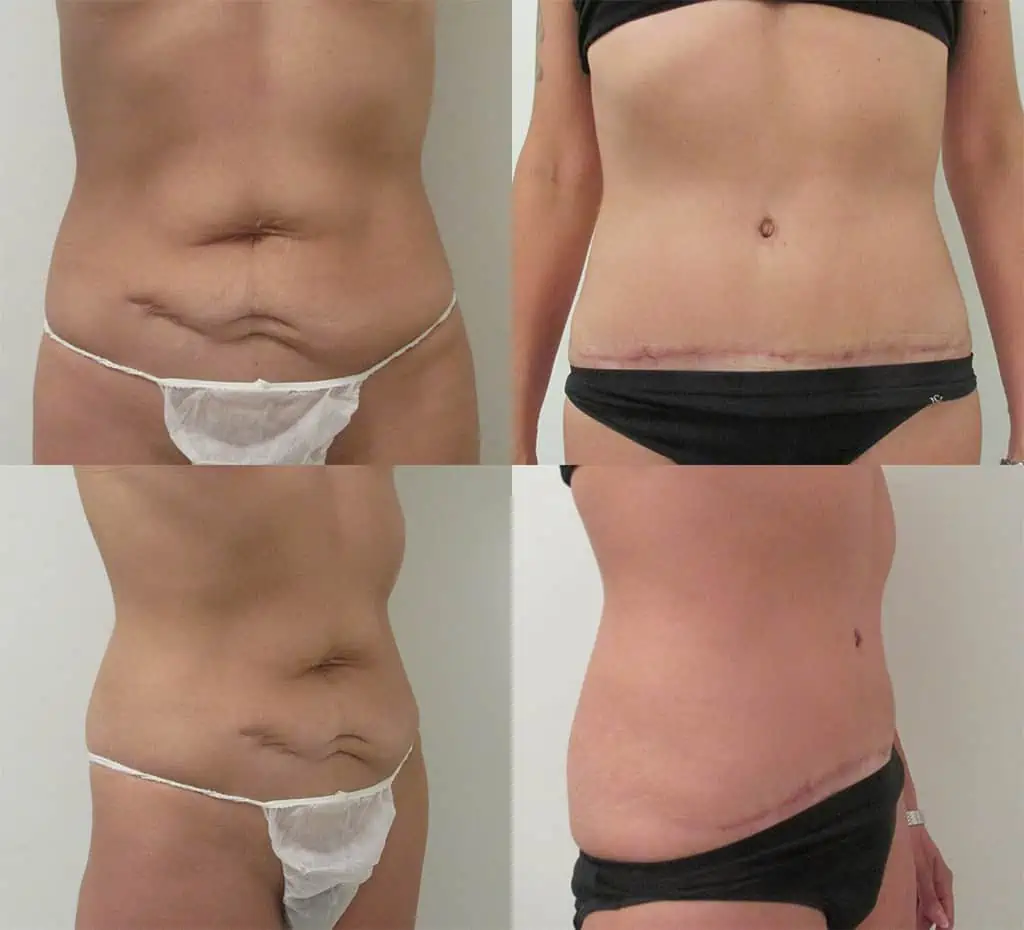
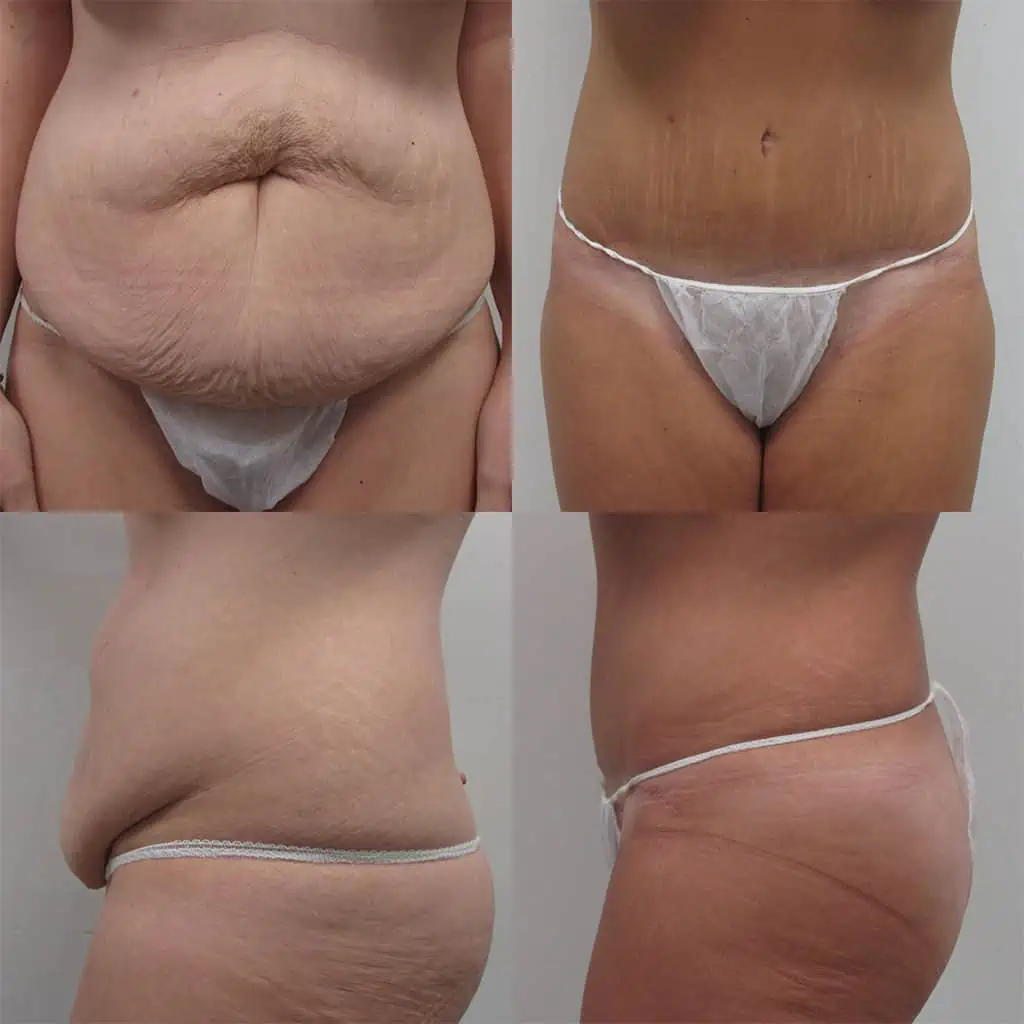
Tummy Tuck Pictures After 3 Months: What You Should — and Shouldn’t — Expect to See
Three months is the milestone that catches a lot of patients off guard. They feel good. They’re back at work, back at the gym, back to their normal routine. But when they look in the mirror, the result doesn’t quite match what they expected. The lower abdomen still looks a little puffy. The scar is still pink and raised. They start wondering if something went wrong.
Nothing went wrong. This is completely normal, and it’s one of the most important things to understand before surgery.
Most of the dramatic swelling resolves by week six. But subtle residual swelling, especially in the lower abdomen, can linger for up to a year. The lymphatic system — the network of vessels responsible for clearing fluid — takes time to rebuild after surgery. Until it does, you’ll carry some degree of puffiness in the area, particularly at the end of the day or after physical activity. It’s not weight gain. It’s not a complication. It’s healing.
The scar at three months is typically still in an active phase of maturation. It may be firm, slightly raised, and pink or red in color. Over the following six to nine months, it will continue to flatten, soften, and fade. The final scar sits low — well within the bikini line — but its appearance at three months is not its final appearance. Patients who understand this going in are far less anxious about what they see in the mirror at that stage.
If you’re a Fairfield County patient planning a procedure in the fall — which many people do specifically to be recovered before beach season — know that your three-month photos will be taken in January or February. The result you see then is not the result you’ll bring to the beach in June. By summer, you’ll have another three to four months of healing behind you, and the difference is significant.
The most useful thing you can do at the three-month mark is attend your follow-up appointment rather than diagnose yourself online. We can tell you exactly where you are in the healing process and what to expect in the months ahead.
Activity Restrictions During Tummy Tuck Recovery: The Rules That Actually Affect Your Life
The activity restrictions after a tummy tuck aren’t arbitrary. They exist because pushing too hard too early — even once — can compromise your results, reopen the incision, or put unnecessary stress on repaired muscle tissue. Most patients understand this intellectually. The challenge is that real life doesn’t pause for six weeks.
The restrictions that tend to catch people off guard aren’t the obvious ones. Nobody plans to go running at week two. It’s the smaller things — lifting a toddler, reaching overhead to grab something off a shelf, driving before you’re cleared, staying on your feet for a full school event — that add up. Planning for these specifics before surgery makes the recovery significantly smoother.
When Can You Drive, Lift, and Exercise After a Tummy Tuck?
Driving is off the table for at least ten to fourteen days, and longer if your procedure included muscle repair. The reason isn’t just comfort — it’s reaction time. As long as you’re taking prescription pain medication, you cannot legally or safely drive. Beyond that, the physical act of braking requires a quick contraction of your core, which is exactly the area that needs to be protected. Most patients are cleared to drive somewhere around the two-week mark, once they’re fully off prescription medication and have comfortable range of motion.
Lifting restrictions are among the most impactful for Fairfield County patients with young children. For the first six weeks, lifting anything over ten to fifteen pounds is off limits. That means no picking up toddlers, no carrying grocery bags, no moving laundry baskets. If you have children at home, you need a plan for this before surgery — not the day after. Arrange coverage for school drop-off and pick-up, after-school activities, and anything that involves carrying or chasing. This is one of the most common things patients underestimate, and it’s worth being completely honest with yourself about your household before you schedule your procedure date.
Exercise is the other major milestone. Light walking is encouraged early — it supports circulation and helps prevent blood clots. But anything that engages the core, raises your heart rate significantly, or involves impact is restricted until the six-week mark at the earliest. After that, we assess each patient individually. Some people are ready to return to full gym activity at six weeks; others need a few more weeks depending on how the muscle repair has healed. We don’t give blanket clearance — we look at where you actually are.
One more thing worth mentioning: sleep position. For the first several weeks, you’ll sleep in a slightly reclined position with your knees elevated — essentially a modified fetal position that reduces tension on the incision. Most patients find this uncomfortable at first but adapt quickly. A recliner chair, or a bed set up with pillows to support this position, makes a real difference in those early nights.
Planning Your Tummy Tuck Recovery Around the Fairfield County Calendar
Recovery doesn’t happen in a vacuum. It happens in the middle of your actual life — your commute, your kids’ schedules, your social commitments, your work calendar. Fairfield County has a particular rhythm to it, and the patients who plan their procedures around that rhythm tend to have a much smoother experience.
The most popular scheduling window in this area is September through November. School has started, the summer social calendar has wound down, and patients have a full recovery window before the holiday season ramps up. A procedure in October means you’re largely functional by Thanksgiving and well into your results by spring. If beach season matters to you — and for a lot of people in Westport, Darien, Greenwich, and Fairfield, it does — a fall procedure gives you the full winter and spring to heal before June.
January and February are the other popular window. The holidays are over, the social calendar is quiet, and there’s no pressure to be in a swimsuit for months. Patients who schedule in January are typically cleared for full activity by mid-March, with results continuing to develop through summer.
One thing that comes up often with our Fairfield County patients who commute into the city: the Metro-North commute is more manageable than driving in early recovery, but it’s still physically demanding when you’re two weeks post-op. Plan for shorter days initially. If your job allows remote work for the first week or two of your return, take it. Standing on a train platform, navigating Grand Central, and sitting in a desk chair for eight hours is a lot to ask of a body that’s still healing — even if you technically feel okay.
There’s also an emotional dimension to recovery that almost nobody talks about, and it’s worth naming. In the first few days after surgery — typically around days two through five — many patients feel a wave of anxiety, doubt, or low mood. The anesthesia has worn off, the discomfort is real, the results are invisible under swelling, and it’s easy to wonder if you made the right decision. This is a documented, temporary phenomenon, and it passes. Knowing it’s coming makes it much easier to move through.
What to Do Before Your Tummy Tuck to Make Recovery Easier
The patients who recover most smoothly are the ones who planned honestly — not optimistically. They arranged childcare coverage for the full six weeks of restrictions, not just the first two. They told their employer they’d need two weeks minimum, not one. They set up their recovery space before surgery, stocked the kitchen, and lined up help for the things they wouldn’t be able to do themselves.
They also went into surgery knowing that the result they’d see at three months wasn’t the final result — and that the swelling, the tightness, and the maturing scar were all part of a process that takes closer to a year to complete.
If you’re considering a tummy tuck in Fairfield County, CT and want to talk through the specifics of recovery as they apply to your life — your schedule, your household, your procedure type — that’s exactly the kind of conversation we have during consultations at our Stamford office. Reach out to Dr. CS Kim Plastic Surgery to get started.